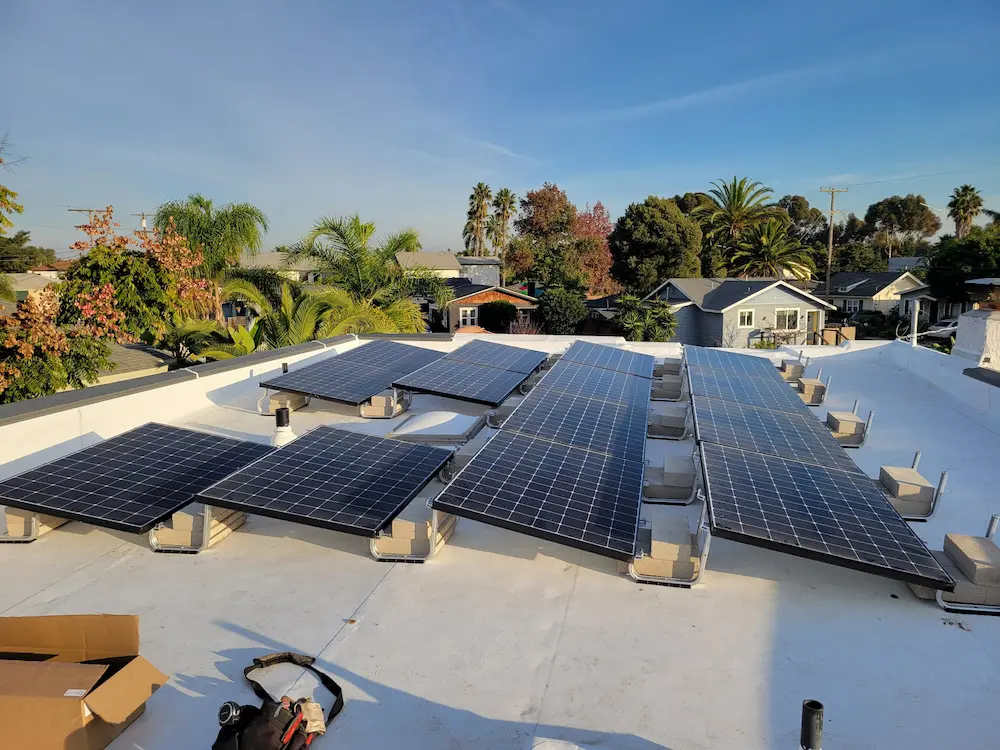
If you are reading roofing and solar websites in San Diego right now, you are going to see the number 30% a lot. It is out of date. The federal residential solar tax credit that homeowners had claimed for twenty years, under Internal Revenue Code section 25D, no longer applies to expenditures made after December 31, 2025. That is not an interpretation. The statute says it directly: the credit does not apply to any expenditures made after that date (26 U.S.C. §25D(h)).
We are a roofing and solar company. It would be more convenient for us if that were not true. It is true anyway, and you are going to find out eventually, so you should find out from us rather than from a contractor still running a 2024 slide deck.
This post covers what changed, what is genuinely still available in 2026, why the export credit is no longer the reason to go solar in SDG&E territory, why the battery is the reason now, what solar does not remove from your bill, and how to check any incentive number a contractor, including us, puts in front of you.
TL;DR
- The federal 25D credit for homeowner-owned residential solar ended for any system completed after December 31, 2025. Completion date matters, not contract date or deposit date.
- Under NEM 3.0 (the net billing tariff, in effect since April 15, 2023), exported solar power is credited well below retail rates, so a battery paired with solar carries most of the savings now.
- SDG&E's on-peak window is 4pm to 9pm. A right-sized system with storage that avoids buying power in that window usually beats an oversized panel-only array.
- California's property tax exclusion for solar still applies to systems completed before January 1, 2027, and SGIP battery rebates are mostly closed in SDG&E territory right now.
What actually changed with the federal solar tax credit?
Two things changed, and the second one is the one that catches people. First, the credit terminated. Section 25D was ended by Public Law 119-21, signed in July 2025. For a residential system you own, there is no 30% federal credit available in 2026.
Second, the IRS measures the deadline by completion, not by payment. This is where a lot of homeowners got hurt. The rule is that an expenditure is treated as made when the original installation of the item is completed. The IRS spelled out the consequence directly: if installation is completed after December 31, 2025, the expenditure is treated as made after that date, which prevents the taxpayer from claiming the section 25D credit (IRS FAQs on OBBB modifications).
- A contract signed in October 2025 did not preserve the credit.
- A deposit paid in December 2025 did not preserve it.
- A system still waiting on permit or interconnection when the calendar turned did not preserve it.
- Only a completed installation before January 1, 2026 qualified.
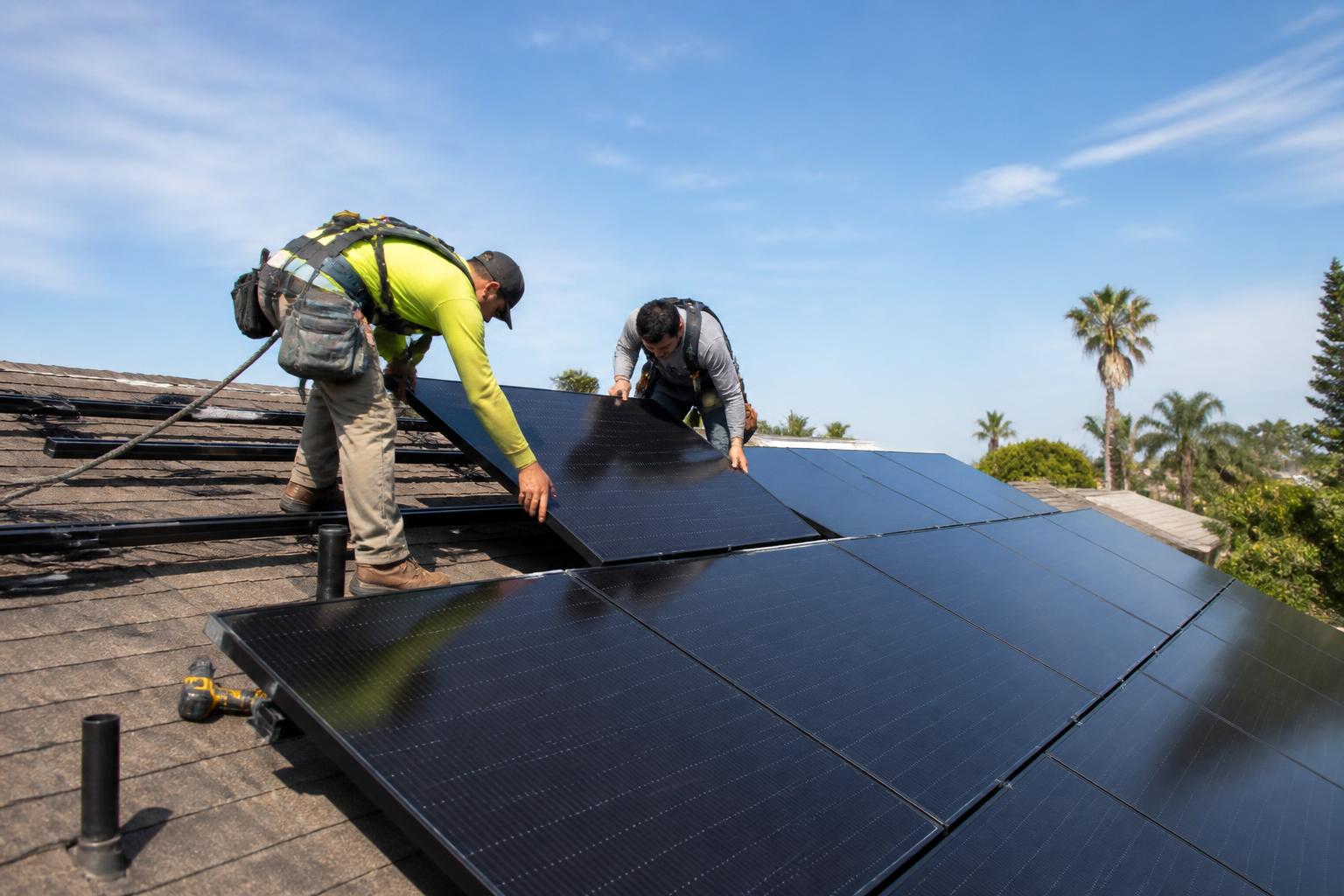
What incentives are genuinely still available in 2026?
Here is the honest inventory. Every item below is dated, because every one of them can move.
Commercial solar, on a clock
Section 48E, the clean electricity investment credit, is alive for business-owned systems, but the timeline tightened sharply. Solar facilities that began construction after July 4, 2026 must be placed in service by December 31, 2027 to claim it. Energy storage is carved out of that solar and wind sunset. If you own a commercial building in Miramar, Kearny Mesa, or Poway, this is a real deadline and the engineering lead time is not short. Talk to your CPA before you talk to us.
Lease and PPA arrangements are structurally different
With a lease or a power purchase agreement, you do not own the system, so there is nothing for you to claim directly. Any benefit reaches you only as a lower price or rate, if the provider chooses to pass it through. Ask to see the escalator, the term, the buyout, and what happens if you sell the house or need a roof replacement under the array.
California's property tax exclusion, expiring soon
An active solar energy system currently does not trigger a property tax reassessment as new construction, but only for systems in progress or completed before January 1, 2027 (California BOE guidance). Systems excluded before the sunset stay excluded until the property changes ownership. This is one of the few genuine 2026 deadlines left, and it is a completion deadline, not a contract deadline.
SGIP battery rebates, mostly closed
The Self-Generation Incentive Program is administered here by the Center for Sustainable Energy. As of the program's own metrics dated August 20, 2026, the general Small Residential Storage category shows closed, at a Step 7 rate of $0.15 per watt-hour. Higher equity rates belong to income-qualified categories, and those show closed or waitlisted as well. We are not going to quote you a battery price with an SGIP rebate subtracted out of it. If a category reopens and you qualify, we will tell you and help you file.
There is no California state income tax credit for residential solar. There never was one in the sense people mean.
How does NEM 3.0 change what solar is worth in San Diego?
Under the net billing tariff, called NEM 3.0, which has applied to every new interconnection since April 15, 2023, the energy you send back to the grid is credited at values from the CPUC's Avoided Cost Calculator, which the CPUC itself describes as usually lower than import rates (CPUC, Net Energy Metering and Net Billing).
Practically: the kilowatt-hour your panels make at 11 a.m. and push to the grid is not worth the same as the kilowatt-hour you buy back at 6 p.m. It is worth considerably less. An oversized array that exports heavily in the middle of the day is no longer the efficient design it was under NEM 2.0.
Usually lower than import rates.
Want your roof checked before panels go up?
Free inspection across Southern California, with photos of exactly what we find.
Why does a battery matter more than the panel count now?
SDG&E's on-peak window is 4 p.m. to 9 p.m. SDG&E's own guidance to solar customers is to try to use your battery during on-peak hours from 4pm to 9pm when electricity is priced the highest (SDG&E Solar Billing Plan).
That is the whole economics of solar in San Diego in 2026, compressed into one sentence. The value is in not buying expensive evening electricity, not in selling cheap midday electricity. The CPUC reports that roughly 70% of net billing customers paired storage with their solar by the end of 2024, and that is why.
It also means a smaller, well-matched array with storage frequently beats a bigger array without it. We would rather sell you the right system twice, panels now, storage when it pencils, than an oversized one once. See our solar battery installation and Tesla Powerwall installation pages for what that looks like in practice.
What does solar not remove from your electric bill?
This gets left out of a lot of proposals, so here it is plainly. SDG&E's Base Services Charge applies to residential customers including solar customers, because the house is still connected to the grid. It runs roughly $24 per month for general residential customers, about $12 for FERA/DRAH, and about $6 for CARE, effective October 2025. Solar export credits do not net against it.
There are also non-bypassable charges for public purpose programs that export credits cannot offset. So "solar eliminates your electric bill" is not a thing that happens. "Solar substantially reduces the usage-based portion of your bill, and a battery attacks the most expensive hours" is a thing that happens.
- We will not give you a savings number before we have seen a full year of your bills.
- We will not tell you that you need a new roof when you don't - check with a roof inspection first.
- We will not quote a federal residential tax credit, because there isn't one for homeowner-owned systems completed in 2026.

How do I check any incentive number a contractor gives me?
This is not a trick and it is not aimed at any particular competitor. Most solar salespeople in San Diego are working from slide decks that were accurate in 2024 and were never updated. Here is how to check any of it yourself, in about fifteen minutes.
- 1Ask for the incentive by name and citation - not "the tax credit," but the section number, the program name, or the tariff schedule.
- 2Look up whether it applies to owned systems, leased systems, or both.
- 3Check the completion deadline, not the contract deadline.
- 4Confirm your utility territory - SDG&E, or a Community Choice program like San Diego Community Power - since generation charges differ.
- 5Ask what your system's export credits are actually worth under the current tariff, not the old one.
If you want a straight answer on your own roof and your own bills, contact us and send twelve months of statements. We'll model it before we quote it. If your roof needs work first, look at solar panel removal and reinstallation and solar installation, and check your provider on the utility companies page.
Frequently asked questions
About the author
The McKay Roofing & Solar Crew
Licensed roofers and solar installers (CSLB 1130793), on Southern California roofs since 1981
Read more about McKay Roofing & SolarGet a straight number, not a 2024 slide deck
Send us twelve months of SDG&E statements and we'll model what solar and storage actually do for your bill in 2026, incentives included and excluded honestly.